
The Ultimate Guide to Social Media Design: Build a Powerful Brand Presence in 2026

In today's digital world, social media is often the first place where potential customers discover a business. Before visiting a website, requesting a quote, or making a purchase, people usually check a brand's Instagram, Facebook, LinkedIn, or other social platforms to understand its personality, professionalism, and credibility.
This is why social media design has become far more than simply creating attractive posts. Every visual shared online represents the brand's identity, values, and quality. Well-designed social media graphics help businesses communicate clearly, build trust, increase engagement, and create memorable experiences that encourage people to follow, interact, and eventually become customers.
Whether you're a startup, an established company, an e-commerce brand, or a personal brand, your audience forms an opinion within seconds of seeing your content. A cluttered design, inconsistent branding, or poor-quality graphics can reduce credibility before someone even reads your message. On the other hand, professionally designed social media content instantly communicates confidence, consistency, and expertise.
Social media platforms continue to evolve every year. Algorithms prioritize engaging content, users expect visually appealing experiences, and competition grows stronger across every industry. Businesses that invest in strategic design rather than random graphics stand out more effectively and create lasting relationships with their audience.
Professional social media design combines branding, marketing psychology, typography, color theory, visual hierarchy, storytelling, and user behavior into one cohesive strategy. Every post should have a purpose—whether it is educating, inspiring, promoting, or building trust. Great design doesn't just attract likes; it supports long-term business growth.
In this comprehensive guide, you'll learn everything about professional social media design, including the different types of social media graphics, essential design principles, platform-specific strategies, common mistakes to avoid, the latest design trends, and expert insights that help businesses create a powerful and recognizable online presence.
By the end of this guide, you'll understand how strategic social media design can strengthen your brand identity, improve engagement, and help your business achieve sustainable growth across today's most important digital platforms.

💡 Pro Tip
Before designing your first social media post, define your brand identity, target audience, and content goals. A beautiful design without a clear strategy rarely delivers consistent business results.
What Is Social Media Design?
Social media design is the strategic process of creating visual content that communicates a brand's message, personality, and values across digital platforms. It goes far beyond making attractive graphics. Every visual element—whether it's a static post, carousel, story, banner, advertisement, or reel cover—works together to strengthen brand recognition and encourage meaningful audience engagement.
In today's competitive digital landscape, businesses are no longer judged only by the quality of their products or services. They are also evaluated by how professionally they present themselves online. A well-designed social media profile instantly creates a positive first impression, while inconsistent or poorly designed content can reduce trust within seconds.
Professional social media design combines creativity with strategy. It uses visual hierarchy, typography, color psychology, spacing, imagery, and branding principles to ensure that every piece of content serves a specific purpose. Rather than simply decorating information, effective design guides the viewer's attention, improves readability, and encourages action.
For example, an educational carousel should make complex ideas easy to understand through structured layouts and clear typography. A promotional post should highlight the most important offer without overwhelming the audience. A testimonial graphic should build credibility through clean presentation and authentic storytelling. Although these formats look different, they all share the same objective: helping the audience connect with the brand.
Another important aspect of social media design is consistency. Successful brands maintain a recognizable visual identity across every platform. Their colors, fonts, layouts, icon styles, and graphic elements remain consistent, making their content instantly familiar even before users read the text. This consistency strengthens brand recall and helps businesses stand out in crowded social feeds.
Modern social media design is also closely connected with user behavior. People scroll quickly, often making decisions within a few seconds. Because attention spans are limited, visuals must communicate their message immediately. Strong contrast, clear headlines, balanced composition, and strategic use of white space help stop users from scrolling and encourage them to interact with the content.
Beyond attracting attention, social media design also supports long-term marketing goals. High-quality visuals increase engagement, improve content sharing, reinforce brand positioning, and create a professional image that attracts potential customers. Every design should contribute to building stronger relationships rather than simply generating temporary likes.
Ultimately, social media design is not about creating content that looks fashionable for a short period. It is about building a visual communication system that reflects the brand's identity, supports business objectives, and creates a memorable experience for every viewer.

💡 Pro Tip
Never design social media graphics just to fill your posting schedule. Every visual should answer one simple question:
"What action should the viewer take after seeing this post?"
When every design has a clear objective, your content becomes more valuable, memorable, and effective at driving real business results.
Why Social Media Design Matters: The Business Impact of Great Visual Communication
Every day, millions of businesses publish content across Instagram, Facebook, LinkedIn, Pinterest, X, and other social media platforms. Yet only a small percentage of those posts manage to capture attention, encourage engagement, and leave a lasting impression.
The difference is rarely the algorithm alone.
More often, the difference lies in the quality of visual communication.
Social media users are exposed to an endless stream of content. As they scroll, they make split-second decisions about what deserves their attention. A well-designed post encourages them to pause, while an unorganized or inconsistent design is often ignored before the message is even noticed.
This is why professional social media design has become an essential part of modern branding.
It helps businesses communicate faster, appear more trustworthy, and remain memorable in an increasingly competitive digital environment.
A strong visual identity does more than attract attention.
It builds relationships.
It creates recognition.
It strengthens credibility.
And over time, it becomes one of the most valuable assets a brand owns.
First Impressions Are Created in Seconds
When someone discovers your business for the first time, they often visit your social media profile before exploring your website or contacting you.
Within a few moments, they begin answering important questions in their mind.
Does this business look professional?
Can I trust this brand?
Are they active and consistent?
Do they understand their audience?
Is their content valuable?
Interestingly, these questions are often answered visually before a single caption is read.
A profile filled with consistent colors, clean layouts, readable typography, and high-quality graphics immediately creates confidence.
In contrast, inconsistent templates, random fonts, poor image quality, and cluttered compositions may create uncertainty—even if the products or services are excellent.
Your visual presentation shapes expectations long before a conversation begins.
Consistency Builds Recognition
Think about the brands you recognize instantly.
Often, you can identify their content before seeing their logo because their visual style remains consistent.
This consistency is intentional.
Professional brands create design systems rather than isolated graphics.
They use the same typography, color palette, spacing, icon style, photography direction, and layout principles across every platform.
Over time, this repetition creates familiarity.
Familiarity creates recognition.
Recognition creates trust.
And trust influences purchasing decisions.
Social media design should therefore support the overall brand identity rather than changing with every post.
Consistency does not make content repetitive.
It makes the brand memorable.
💡 Pro Tip
Create a simple design system before designing individual posts.
Define your colors, typography, spacing, icon style, button style, and layout rules first.
Design becomes faster, more consistent, and significantly more professional.

Social Media Design Influences Engagement
People engage with content that is easy to understand.
A confusing design forces users to work harder.
A clear design guides their attention naturally.
Professional designers use visual hierarchy to answer three questions almost immediately.
What is this post about?
Why should I care?
What should I do next?
Large headlines, balanced spacing, contrasting colors, and clear call-to-action elements reduce cognitive effort and make content easier to consume.
This increases the likelihood of likes, comments, shares, saves, and profile visits.
Good design doesn't guarantee engagement.
However, poor design often prevents good content from receiving the attention it deserves.
Strong Design Supports Business Growth
Many businesses still view social media as a place to post occasional updates.
Successful brands see it differently.
Every post contributes to marketing.
Every carousel builds authority.
Every testimonial increases credibility.
Every educational graphic strengthens trust.
Every promotional campaign creates opportunities for conversion.
Professional social media design ensures that each piece of content supports long-term business goals instead of existing as an isolated graphic.
The result is a stronger brand, a more engaged audience, and a more professional online presence.
⭐ Expert Insight
Social media design should never chase trends at the expense of brand identity.
Temporary trends may increase visibility for a short period, but consistent branding builds recognition that lasts for years.
📊 Quick Comparison
Inconsistent Social Media Design | Professional Social Media Design |
Random fonts and colors | Consistent brand identity |
Weak visual hierarchy | Clear communication |
Low audience trust | Strong professional image |
Difficult to recognize | Instant brand recall |
Posts created individually | Unified design system |
📌 Key Takeaways
Social media design creates the first impression of your business.
Consistency strengthens recognition and customer trust.
Clear visual hierarchy improves engagement and readability.
Every post should support long-term branding, not just short-term visibility.
Professional design transforms social media into a powerful business communication tool.
Types of Social Media Designs: Understanding Every Content Format That Builds a Strong Brand
Many businesses believe that social media design means creating an occasional Instagram post or adding text to a photo. In reality, professional social media design is a complete visual communication system made up of different content formats, each serving a unique purpose.
Every social media platform encourages different user behavior.
People browse Instagram for inspiration, Facebook for communities and updates, LinkedIn for professional insights, Pinterest for ideas, and YouTube for educational or entertaining videos.
Because audiences interact differently on each platform, businesses cannot rely on a single design style for every piece of content.
Instead, successful brands build a balanced content strategy that combines multiple design formats to educate, engage, inspire, promote, and convert their audience.
Understanding these content formats helps businesses create meaningful experiences instead of publishing repetitive posts.
Let's explore the most important types of social media designs used by modern brands.
Single Image Posts
Single-image posts remain one of the most effective content formats for delivering clear and focused messages.
Unlike carousel posts that tell a longer story, a single-image post communicates one primary idea.
This format is ideal for announcements, product launches, promotional offers, inspirational quotes, customer testimonials, company updates, and brand awareness campaigns.
The strength of a single-image design lies in simplicity.
A powerful headline, strong visual hierarchy, limited text, and a clear call to action often perform better than overcrowded layouts.
Professional designers carefully balance typography, imagery, white space, and branding to ensure that viewers understand the message within a few seconds.
When executed well, single-image posts are highly shareable and easy to consume across almost every social media platform.
💡 Pro Tip
One design should communicate one idea.
Trying to explain multiple messages in a single post often reduces clarity and weakens engagement.

Carousel Posts
Carousel posts allow businesses to tell a story across multiple slides.
Instead of presenting all information at once, the content is divided into smaller sections that encourage users to swipe through the entire sequence.
This format is especially valuable for educational content, step-by-step tutorials, case studies, product comparisons, industry insights, and storytelling.
Each slide should naturally lead to the next.
The first slide captures attention.
The middle slides build value.
The final slide encourages action.
Professional carousel design maintains visual consistency while introducing enough variation to keep users interested.
Because users spend more time interacting with carousel content, many platforms consider it a strong engagement format.
When designed thoughtfully, carousel posts increase saves, shares, and overall audience retention.
⭐ Expert Insight
Don't design each carousel slide as an individual post.
Design the entire sequence as one connected story.
A smooth visual flow encourages users to continue swiping until the final slide.

Stories
Stories are designed for fast, temporary communication.
Because they disappear after a limited period, they create a sense of urgency and encourage immediate interaction.
Businesses use stories for behind-the-scenes content, product updates, limited-time offers, customer polls, event reminders, and daily engagement.
Unlike regular posts, stories should feel more conversational while still maintaining brand consistency.
Readable typography, bold visuals, and clear calls to action improve performance.
Interactive features such as polls, quizzes, countdowns, and question stickers make stories even more engaging by encouraging audience participation.
For many brands, stories help build stronger relationships because they provide a more authentic and personal connection with followers.

Reels Covers and Video Thumbnails
Short-form video has become one of the fastest-growing content formats across social media.
However, viewers often decide whether to watch a video based on its cover image.
A professionally designed reel cover creates consistency across the profile while helping users quickly understand the video's topic.
Good reel covers use clear typography, strong contrast, recognizable branding, and minimal visual clutter.
Similarly, YouTube thumbnails should attract attention without becoming misleading.
Effective thumbnails communicate curiosity, clarity, and value while remaining consistent with the overall brand identity.
💡 Pro Tip
Treat every thumbnail as the headline of your content.
If it fails to capture attention, many viewers will never discover the value inside the video.

📊 Quick Comparison
Content Format | Best Use Case |
Single Image Post | Promotions, announcements, quotes |
Carousel Post | Education, storytelling, tutorials |
Story | Daily engagement, behind the scenes, limited-time offers |
Reel Cover | Short-form video branding |
YouTube Thumbnail | Increase video clicks and recognition |
📌 Key Takeaways
Different content formats serve different marketing objectives.
Single-image posts communicate one strong message quickly.
Carousels improve storytelling and educational engagement.
Stories strengthen daily interaction and authenticity.
Reel covers and thumbnails influence whether users choose to watch your content.
A balanced mix of content formats creates a stronger and more effective social media strategy.
The Professional Social Media Design Process: From Strategy to Publishing
Many people assume that social media design begins with opening design software and choosing a template.
Professional designers think differently.
Before selecting colors, fonts, or images, they first understand the purpose behind the content. Every successful social media design starts with strategy because great visuals without a clear objective rarely produce meaningful business results.
Professional agencies don't ask, "What should we post today?"
Instead, they ask,
"What business goal should today's content support?"
This small change in mindset transforms social media from random posting into a structured marketing system.
Whether the objective is increasing brand awareness, generating leads, educating customers, launching a product, or improving engagement, every design decision should support that goal.
Let's explore how professional designers create social media content that is both visually appealing and strategically effective.
Step 1: Understanding the Brand
Before creating a single graphic, designers must understand the brand they are representing.
Every business has its own personality, audience, values, and communication style.
A premium luxury brand should not look like a playful children's brand.
A technology company should not communicate in the same visual language as an organic skincare business.
Professional designers begin by asking important questions such as:
What does the business do?
Who is the ideal customer?
What problems does the brand solve?
What emotions should people associate with the brand?
What makes the business different from its competitors?
The answers become the foundation for every future design.
Without this understanding, even attractive graphics may fail to communicate the right message.
💡 Pro Tip
Never copy another brand's visual style simply because it looks attractive.
Your design should reflect your own brand personality, audience, and long-term positioning.
Originality builds recognition.

Step 2: Planning Content Before Designing
Professional designers never create posts randomly.
They first develop a content plan that aligns with the brand's marketing objectives.
This planning stage helps maintain consistency while ensuring the audience receives a healthy balance of educational, promotional, inspirational, and community-focused content.
Instead of posting only advertisements, successful brands combine different content categories such as:
Educational Posts
Tips and Tutorials
Customer Success Stories
Product Highlights
Behind-the-Scenes Content
Industry Insights
Frequently Asked Questions
Brand Stories
Promotional Campaigns
Seasonal Content
Planning content in advance also makes it easier to maintain a consistent publishing schedule and reduces last-minute creative pressure.
Many agencies use monthly content calendars to organize campaigns, product launches, holidays, and marketing initiatives before beginning the design process.
A well-planned calendar ensures every design contributes to a larger business objective rather than existing as an isolated graphic.
⭐ Expert Insight
Consistency is built through planning—not creativity alone.
Brands that publish with a clear strategy are more likely to develop loyal audiences than those posting only when inspiration appears.

Step 3: Designing with Purpose
Once the strategy and content plan are complete, designers begin creating visuals.
Every element should serve a purpose.
Typography should improve readability.
Colors should strengthen brand identity.
Images should support the message.
White space should improve focus.
Call-to-action elements should encourage the desired response.
Professional designers avoid adding unnecessary decorations simply to make a post look busy.
Instead, they prioritize clarity, balance, and communication.
A successful social media design should answer three questions almost immediately:
What is this post about?
Why should I care?
What should I do next?
If these answers are clear, the design has already achieved one of its primary objectives.
💡 Pro Tip
Before publishing any design, reduce unnecessary elements.
If removing an element makes the message clearer, it probably wasn't needed in the first place.
Simple designs often communicate more effectively than complicated ones.

📊 Quick Comparison
Random Content Creation | Strategic Social Media Design |
Posts created without planning | Content planned around business goals |
Inconsistent branding | Unified visual identity |
Focus on appearance only | Focus on communication and results |
Irregular publishing | Organized content calendar |
Short-term engagement | Long-term brand growth |
📌 Key Takeaways
Great social media design begins with strategy, not software.
Understanding the brand creates stronger and more meaningful visuals.
Content planning improves consistency and marketing performance.
Every visual element should support a clear communication goal.
Simplicity and clarity are often more effective than unnecessary complexity.
Brand Consistency Across Social Media Platforms: Building a Recognizable Digital Identity
One of the biggest differences between ordinary businesses and memorable brands is consistency.
Many companies create excellent individual social media posts, yet their overall online presence feels disconnected. One day they use bold typography and dark colors. The next day they switch to bright colors, different fonts, unrelated layouts, and inconsistent imagery.
Although each design may look attractive on its own, the brand slowly loses its identity.
Professional social media design is not about creating beautiful posts independently.
It is about creating a visual system where every post feels like part of the same story.
Imagine opening the Instagram profile of a premium coffee brand.
Every post uses the same color palette.
The typography follows a consistent style.
Photography maintains a similar mood.
Icons, layouts, and spacing feel familiar.
Even before reading the logo, you recognize the brand.
That level of recognition is not accidental.
It is the result of a carefully developed design system.
Brand consistency creates familiarity.
Familiarity builds trust.
Trust encourages customers to engage, remember the business, and eventually make purchasing decisions.
This is why successful brands invest in visual consistency across every platform rather than redesigning their identity with every new campaign.
Consistency Does Not Mean Repetition
Many designers mistakenly believe consistency means making every post look identical.
In reality, consistency provides structure while allowing creativity.
Think of it like architecture.
Different rooms inside a home serve different purposes, but they still belong to the same building because they share common materials, proportions, and design language.
Social media works in the same way.
An educational carousel, a promotional banner, a customer testimonial, and an event announcement should all look different enough to remain interesting.
However, they should also share recognizable branding elements.
Professional brands usually maintain consistency through:
Color Palette
Typography
Logo Placement
Icon Style
Graphic Elements
Photography Style
Grid System
White Space
Illustration Style
These elements create a recognizable identity while allowing endless creative possibilities.
💡 Pro Tip
Build a design system before building content.
A strong design system saves time, improves consistency, and makes every future design easier to create.

Adapting Without Losing Your Identity
Every social media platform has different dimensions, user behavior, and content expectations.
Instagram emphasizes visual storytelling.
LinkedIn values professional insights.
Facebook supports community interaction.
Pinterest focuses on discovery and inspiration.
YouTube relies heavily on thumbnails and video branding.
Although the formats differ, your identity should remain recognizable.
For example, a LinkedIn graphic may use a cleaner and more corporate layout, while the same message on Instagram may include stronger visual storytelling.
The presentation changes.
The brand does not.
This flexibility allows businesses to optimize content for each platform without confusing their audience.
Successful brands adapt their communication while preserving their identity.
⭐ Expert Insight
People don't remember individual posts.
They remember consistent brands.
Recognition is built through repetition of identity—not repetition of design.
Creating a Professional Design System
Instead of designing every post from scratch, professional agencies create reusable design systems.
These systems typically include:
Primary and Secondary Colors
Font Pairings
Logo Usage Rules
Grid Layouts
Button Styles
Icon Library
Image Treatments
Carousel Templates
Story Templates
CTA Components
This approach improves efficiency while ensuring every design feels connected.
It also becomes easier for teams to collaborate because everyone follows the same visual guidelines.

📊 Quick Comparison
Inconsistent Branding | Consistent Branding |
Different colors every week | Fixed color palette |
Random typography | Standardized typography |
Changing visual style | Recognizable design system |
Weak brand recall | Strong brand recognition |
Difficult to scale | Easy to maintain across teams |
📌 Key Takeaways
Brand consistency creates familiarity and trust.
Consistency is achieved through systems, not repetition.
Every platform should reflect the same brand identity while adapting to platform-specific formats.
Reusable templates improve both efficiency and quality.
A strong design system helps businesses build long-term recognition instead of short-term attention.
Common Social Media Design Mistakes That Reduce Engagement and Damage Brand Trust
Creating attractive graphics is easier than ever. With countless design tools, templates, and AI-powered platforms available today, almost anyone can produce a visually appealing post within a few minutes.
However, attractive design does not always mean effective design.
Many businesses invest time and effort into creating content, yet their posts receive very little engagement, fail to build trust, and rarely convert viewers into customers.
The problem often isn't the algorithm.
It isn't the platform.
And it isn't always the content.
In many cases, the biggest issue is poor design strategy.
Professional social media design is built around communication, clarity, consistency, and user experience. When these principles are ignored, even high-quality content can lose its impact.
Let's explore the most common mistakes that prevent social media designs from achieving their full potential.
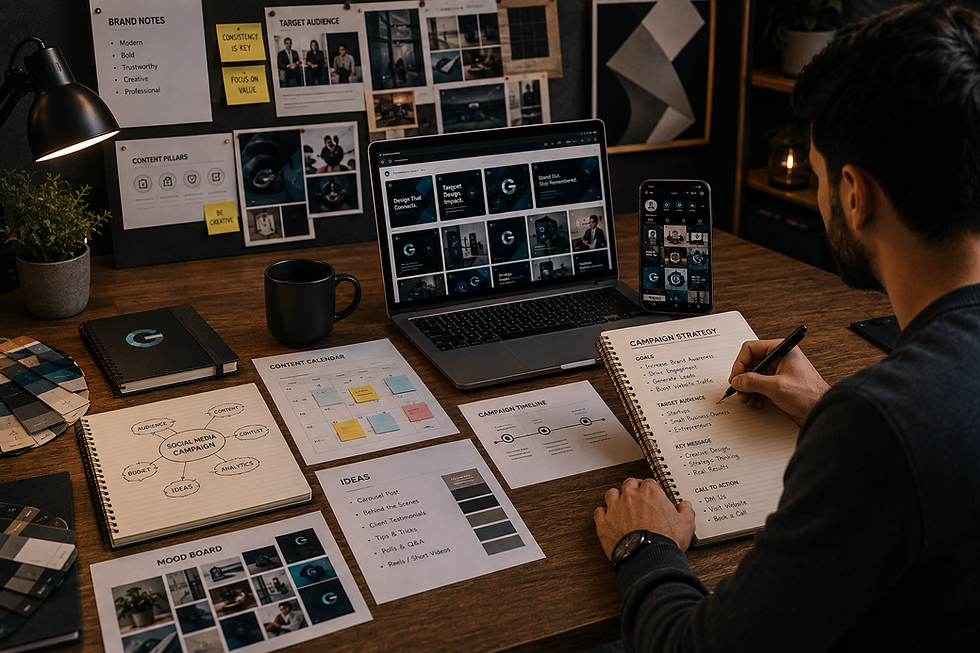
Mistake 1: Designing Without a Clear Goal
Every successful social media post begins with one important question.
What should this post achieve?
Many businesses create graphics simply because they want to stay active online.
Unfortunately, publishing content without a purpose usually leads to weak engagement and inconsistent messaging.
Before opening any design software, define the objective.
Do you want to educate your audience?
Promote a product?
Generate leads?
Increase website traffic?
Build brand awareness?
Every design decision should support that single objective.
When the purpose is clear, the message becomes stronger and the design becomes more effective.
💡 Pro Tip
Never start by asking, "What should I design today?"
Instead ask,
"What business goal should today's design help achieve?"
This simple shift creates more meaningful content and better marketing results.
Mistake 2: Inconsistent Branding
One of the fastest ways to weaken a brand is inconsistency.
Different fonts.
Different colors.
Different logo placements.
Different visual styles.
Although each design may look acceptable individually, together they create confusion.
Customers should immediately recognize your content before reading the logo.
Consistency builds familiarity.
Familiarity builds trust.
Professional brands maintain the same visual language across every platform while allowing enough flexibility to keep content fresh.
Mistake 3: Too Much Text
Many businesses try to include an entire article inside a single social media graphic.
As a result, typography becomes too small, layouts become crowded, and users continue scrolling without reading.
Social media is designed for quick communication.
Keep headlines short.
Highlight one core message.
Move detailed explanations into the caption or carousel slides.
Simple communication almost always performs better than information overload.
⭐ Expert Insight
The purpose of social media design is not to say everything.
Its purpose is to encourage people to stop scrolling, understand the message quickly, and take the next step.

Mistake 4: Ignoring Mobile Users
The majority of social media users browse content on smartphones.
Yet many designs are created only for desktop viewing.
Tiny fonts.
Thin icons.
Small buttons.
Low contrast.
All of these reduce readability on mobile devices.
Professional designers always preview their work on mobile screens before publishing.
If a headline cannot be read comfortably on a smartphone, it should be redesigned.
Mobile-first thinking improves accessibility and user experience.
Mistake 5: Using Low-Quality Images
Blurry photographs and stretched graphics reduce credibility instantly.
People often associate visual quality with business quality.
Professional brands use high-resolution photography, clean illustrations, consistent editing styles, and carefully selected imagery that supports the message instead of distracting from it.
Good visuals increase trust.
Poor visuals reduce perceived value.
💡 Pro Tip
Before publishing, zoom out and imagine seeing your post while scrolling quickly on a phone.
If the headline isn't immediately readable and the main message isn't obvious within a few seconds, simplify the design.

📊 Quick Comparison
Common Mistakes | Professional Approach |
Designing without strategy | Designing with clear business goals |
Inconsistent branding | Consistent visual identity |
Too much text | Focused and easy-to-read messaging |
Desktop-only thinking | Mobile-first design approach |
Low-quality visuals | High-resolution professional graphics |
📌 Key Takeaways
Every social media design should support a specific marketing objective.
Consistent branding improves recognition and customer trust.
Simplicity makes content easier to understand and more engaging.
Mobile optimization is essential because most users browse on smartphones.
High-quality visuals strengthen brand perception and improve overall credibility.
Social Media Design Trends (2026): Creating Content That Stays Relevant Beyond Trends
Social media evolves faster than almost any other digital industry.
New platforms emerge.
Algorithms change.
Content formats evolve.
Design styles shift.
What attracts attention today may feel outdated just a year later.
Because of this constant evolution, many businesses make the mistake of chasing every new trend they see online.
While staying updated is important, blindly following trends often creates inconsistent branding and weakens long-term recognition.
Professional brands take a different approach.
Instead of redesigning their identity every few months, they adopt trends that enhance communication while preserving their core visual identity.
Successful social media design is built on timeless design principles first.
Trends simply help modernize the presentation.
Let's explore the most influential social media design trends shaping digital branding in 2026.
Minimalism with Purpose
Minimalism continues to dominate professional branding because it improves communication instead of reducing creativity.
Many brands once believed that adding more colors, icons, effects, and decorative elements would make content more engaging.
Today's audiences prefer clarity.
Modern social media graphics focus on generous white space, strong typography, simple layouts, and one clear message.
Minimalism helps viewers understand information quickly while making content appear more premium and trustworthy.
The goal isn't to remove design elements.
The goal is to remove distractions.
Every element should have a purpose.
If something doesn't improve communication, it probably doesn't belong in the design.
💡 Pro Tip
Don't ask,
"What else can I add?"
Instead ask,
"What can I remove without reducing the message?"
Professional design is often defined by what it leaves out.

Authentic Visual Storytelling
Audiences are becoming increasingly selective about the content they consume.
Perfect stock photography and overly polished graphics often feel less trustworthy than authentic brand experiences.
Modern brands now focus on storytelling.
Instead of only promoting products, they share the people behind the business, the design process, customer success stories, company culture, and real moments from daily operations.
This shift creates stronger emotional connections.
People connect with stories more than advertisements.
Professional designers therefore create graphics that support storytelling instead of simply decorating information.
A thoughtful sequence of visuals can communicate transparency, expertise, and personality in ways that traditional promotional graphics cannot.
⭐ Expert Insight
People rarely remember advertisements.
They remember stories.
Design should help those stories become easier to understand and more emotionally engaging.

Motion-First Content
Static graphics continue to play an important role, but motion has become one of the strongest drivers of engagement.
Animated typography.
Subtle transitions.
Micro-interactions.
Short-form motion graphics.
These elements attract attention while improving content retention.
However, effective motion design supports the message rather than distracting from it.
Simple animations that emphasize key information often outperform complex visual effects.
Businesses should think of motion as an extension of communication rather than entertainment alone.
AI-Assisted Creative Workflows
Artificial intelligence has transformed the design process.
Professional designers now use AI to speed up brainstorming, generate creative references, organize content ideas, improve productivity, and automate repetitive tasks.
However, successful brands understand that AI supports creativity rather than replacing it.
Human judgment remains essential.
Strategic thinking.
Brand understanding.
Visual hierarchy.
Customer psychology.
Storytelling.
These qualities still require human expertise.
The strongest social media content combines AI efficiency with human creativity.
💡 Pro Tip
Use AI to generate possibilities.
Use human creativity to make the final decisions.
Technology can accelerate design, but it cannot replace strategic thinking.

Accessibility and Inclusive Design
Modern social media design is becoming more inclusive.
Brands increasingly consider readability, color contrast, font sizes, and accessible layouts to ensure content can be understood by a wider audience.
High contrast improves readability.
Clear typography supports accessibility.
Well-structured layouts reduce cognitive effort.
Inclusive design benefits everyone—not only users with accessibility needs.
Professional brands recognize that making content easier to understand creates a better experience for all audiences.
📊 Quick Comparison
Short-Lived Design Fads | Long-Term Design Strategy |
Chasing every trend | Adopting only relevant trends |
Decorative complexity | Purpose-driven simplicity |
Generic AI graphics | Human-guided creative direction |
Temporary attention | Lasting brand recognition |
Style over communication | Communication supported by style |
📌 Key Takeaways
Modern trends should strengthen—not replace—your brand identity.
Minimalism improves communication through clarity and focus.
Authentic storytelling creates stronger emotional connections than promotional content alone.
Motion design increases engagement when it supports the message.
AI enhances productivity, but human creativity remains essential.
Accessible design improves user experience for every audience.
How GakFix Creates High-Performing Social Media Designs
Successful social media design is never created by accident.
Behind every engaging post, every recognizable brand, and every successful campaign lies a structured creative process built on research, strategy, design thinking, and continuous improvement.
At GakFix, we don't believe in creating graphics simply to fill a posting schedule.
Every design is created with a purpose.
Every visual element supports a business objective.
Every post contributes to building a stronger and more recognizable brand.
Instead of asking,
"What should today's post look like?"
We begin with a much more important question.
"What should today's post accomplish?"
That simple difference changes the entire creative process.
Our goal is not just to make brands look professional.
Our goal is to help businesses communicate more effectively, build stronger customer relationships, and achieve measurable marketing results.
Our Social Media Design Workflow
Every project follows a structured process designed to maintain quality, consistency, and long-term brand growth.
Step 1 — Brand Discovery
We begin by understanding the business.
This includes learning about the company's mission, target audience, products or services, competitors, and long-term marketing goals.
Without understanding the business, design becomes decoration instead of communication.
Step 2 — Content Strategy
Once the brand is understood, we organize content into strategic categories.
For example:
Educational Content
Promotional Campaigns
Customer Testimonials
Product Highlights
Brand Storytelling
Industry Insights
Seasonal Campaigns
Community Engagement
This ensures every post contributes to a balanced content strategy instead of repeating the same type of content.
Step 3 — Visual Identity System
Rather than designing each post from scratch, we create a consistent design system.
This typically includes:
Brand Colors
Typography Rules
Layout System
Icon Style
Photography Direction
Illustration Style
CTA Components
Carousel Templates
Story Templates
Post Templates
This approach improves consistency while making future content easier to produce.
Step 4 — Design and Quality Review
Every design is reviewed for:
Visual hierarchy
Typography readability
Mobile optimization
Brand consistency
Platform dimensions
Accessibility
Marketing clarity
Only after passing these checks is the design prepared for publishing.
💡 Pro Tip
Professional social media design isn't measured by how beautiful it looks.
It's measured by how effectively it communicates the right message to the right audience.

Frequently Asked Questions
How often should businesses post on social media?
Consistency is more important than frequency.
Publishing high-quality content consistently is generally more effective than posting large amounts of low-value content.
Which platform is best for business growth?
There is no universal answer.
The best platform depends on your audience, industry, and business objectives.
Many businesses achieve the best results by combining Instagram, LinkedIn, Facebook, and YouTube as part of an integrated strategy.
Should every platform use identical designs?
No.
The visual identity should remain consistent, but layouts and content should be adapted to match each platform's audience and format.
How important is branding in social media design?
Branding is one of the most important elements.
Consistent branding improves recognition, strengthens trust, and helps businesses build long-term relationships with their audience.
Can AI replace professional social media designers?
AI is an excellent creative assistant.
However, strategic thinking, customer psychology, storytelling, branding, and marketing decisions still require human expertise.
The strongest results come from combining AI efficiency with professional design experience.
📊 Quick Comparison
Ordinary Social Media Content | Professional Social Media Design |
Random posting | Strategy-driven publishing |
Inconsistent visuals | Strong brand identity |
Short-term attention | Long-term audience growth |
Generic templates | Custom brand-focused designs |
Focus on appearance | Focus on communication and business goals |
📌 Final Key Takeaways
Social media design is a strategic branding tool, not simply graphic creation.
Consistency builds recognition, trust, and long-term customer loyalty.
Every design should support a specific marketing objective.
Strong visuals communicate faster than words.
Professional design combines creativity, branding, psychology, and business strategy.
A well-planned content system produces better long-term results than random posting.
Final Thoughts
Social media is no longer just a place to share updates.
It has become one of the most influential spaces where customers discover, evaluate, and remember brands.
Every post contributes to your reputation.
Every design shapes perception.
Every interaction influences trust.
Businesses that invest in strategic social media design create stronger customer relationships, improve brand recognition, and establish a professional presence that stands out in competitive markets.
The goal is not to publish more content.
The goal is to publish better content.
Quality will always outperform quantity when supported by a clear strategy and consistent branding.
Ready to Build a Stronger Social Media Presence?
If you want social media content that does more than collect likes—content that strengthens your brand, builds trust, and supports real business growth—it's time to invest in strategic design.
At GakFix, we help startups, entrepreneurs, and growing businesses create professional social media branding systems that combine creativity with business strategy.
Whether you need Instagram posts, LinkedIn graphics, Facebook campaigns, carousel designs, story templates, or a complete visual identity system, we focus on creating content that communicates clearly and leaves a lasting impression.
Explore our portfolio, discover our branding services, and start building a stronger digital presence with GakFix today.

Comments